203, Maharaja Square, Nr. Maharaja Chowk, Sunpharma Road, Vadodara - 390012


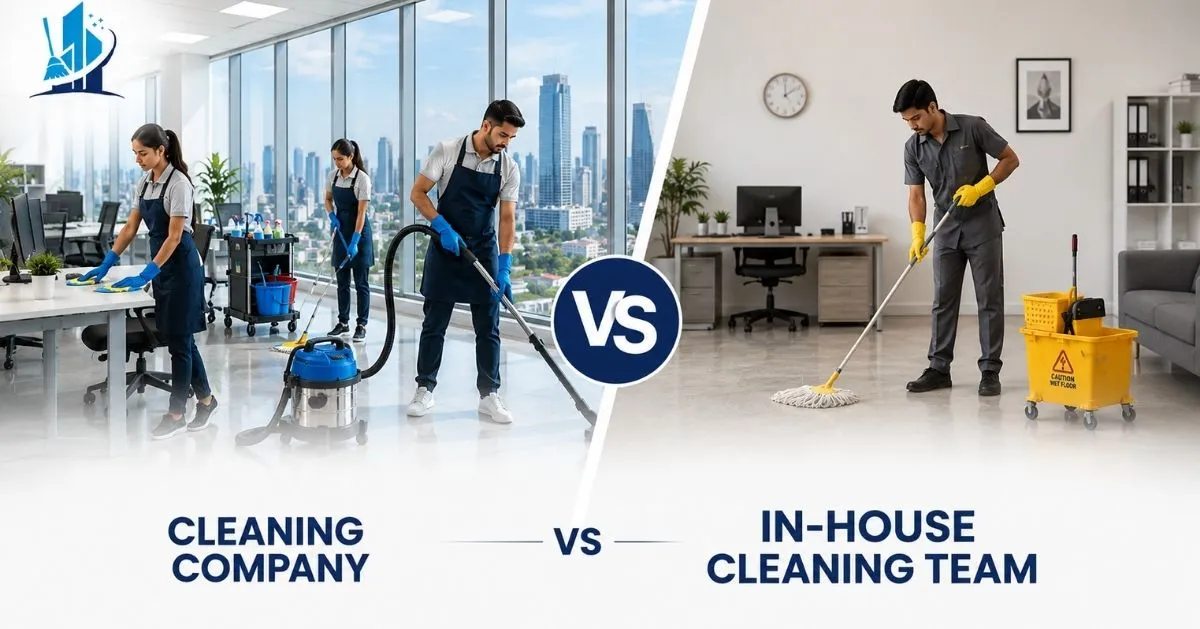
Keeping a workplace clean requires more than occasional dusting or sweeping. Offices, commercial buildings, warehouses, and other business spaces need regular attention to floors, restrooms, workstations, common areas, glass, and high-touch surfaces. When deciding how to manage this work, businesses generally have two choices: build an in-house cleaning team or hire an external provider. A Cleaning Company can take responsibility for regular cleaning while the business focuses on its core operations. An in-house team, on the other hand, gives the business direct control over its cleaning staff and daily routines. Both approaches have advantages, and the better choice depends on factors such as property size, cleaning frequency, staffing requirements, equipment, and budget. Understanding these differences can help businesses choose a practical solution instead of simply selecting the most familiar option.
What Is an In-House Cleaning Team?
An in-house cleaning team consists of employees hired and managed directly by the business. The company is responsible for recruitment, salaries, attendance, training, work schedules, leave management, and performance.
This approach can work well for businesses that need cleaning staff on-site throughout the day or have specific internal processes they want employees to follow.
However, managing an in-house team also means handling the administrative responsibilities that come with maintaining additional employees.
What Is a Professional Cleaning Company?
A professional cleaning provider is an external service that handles cleaning requirements on behalf of a business. Depending on the agreement, the provider may supply cleaning staff, equipment, cleaning products, supervision, and scheduled services.
With a Professional Cleaning Company, businesses can select services according to their property and cleaning requirements instead of managing every cleaning responsibility internally.
This can be particularly useful for offices and commercial properties that need regular cleaning but do not want to maintain a dedicated cleaning department.
Cleaning Company vs In-House Team
The main differences become clearer when comparing how each option handles everyday responsibilities.
| Factor | In-House Cleaning Team | Professional Cleaning Company |
| Staff Management | Managed directly by the business | Managed by the service provider |
| Recruitment | Business handles hiring | Provider supplies staff |
| Training | Business responsibility | Usually handled by provider |
| Equipment | Business purchases and maintains it | Often provided by the company |
| Scheduling | Direct control | Agreed service schedule |
| Replacement Staff | Business must arrange replacements | Provider can manage staffing |
| Scalability | Requires additional hiring | Services can often be adjusted |
| Administration | Higher internal involvement | Less day-to-day management |
Cost and Staff Management
At first glance, an in-house team may appear more economical because the business directly controls salaries and schedules. However, the actual cost can include recruitment, employee benefits, training, uniforms, equipment, cleaning products, leave coverage, and supervision.
With Outsourced Cleaning Services, many of these responsibilities are handled by a Cleaning Company according to the agreed service arrangement.
The right option depends on the size of the cleaning operation and how much internal management the business is prepared to handle.
Equipment and Cleaning Expertise
An in-house team may require the business to purchase vacuum cleaners, floor-cleaning machines, ladders, tools, safety equipment, and cleaning products. Equipment also needs maintenance or replacement over time.
A professional provider may already have access to suitable equipment and trained personnel for different cleaning requirements.
This can be useful when a workplace needs services such as carpet cleaning, deep cleaning, glass cleaning, or other specialized tasks that require more than basic cleaning tools.
Flexibility and Staffing
Businesses can face unexpected staffing challenges when managing an in-house team. Employees may take leave, resign, or become unavailable, leaving the company responsible for finding a replacement.
With Outsourcing Cleaning Services, staffing and replacement arrangements are generally handled by the service provider.
This can make outsourced cleaning more flexible for businesses that need regular service without managing attendance and staffing issues themselves.
Which Option Gives Better Control?
An in-house team gives the business direct control over employees, schedules, and cleaning procedures. This can be useful when cleaning tasks are closely connected to internal operations.
A Cleaning Company offers a different type of control through agreed service schedules, cleaning checklists, supervision, and defined responsibilities. This can reduce the need for businesses to manage cleaning staff directly.
For many businesses, the decision comes down to whether they prefer direct staff management or outsourced operational support.
When Should a Business Choose In-House Cleaning?
An in-house team may be suitable when:
- Cleaning staff are needed throughout the entire working day.
- The business has specific internal cleaning procedures.
- Management wants direct control over staff.
- Cleaning requirements are highly consistent.
- The company already has suitable equipment and supervision.
Large facilities with permanent cleaning requirements may find this approach practical if they have the resources to manage it effectively.
Considering outsourced cleaning for your workplace? Contact Us to discuss a cleaning plan that fits your business needs.
When Is Outsourcing a Better Choice?
Outsourcing may make more sense when a business wants to reduce the administrative workload associated with cleaning staff.
A Cleaning Company can be a practical option when businesses need:
- Scheduled cleaning services
- Trained cleaning personnel
- Specialized cleaning equipment
- Flexible staffing
- Periodic deep cleaning
- Commercial housekeeping
- Less internal staff management
It can also be useful for businesses that want to scale cleaning requirements without recruiting additional employees every time their needs change.
How to Make the Right Choice?
Before deciding between an in-house team and an external provider, consider:
- Property size: How large is the workplace?
- Cleaning frequency: Is cleaning needed daily, weekly, or throughout the day?
- Staffing: How many cleaners are required?
- Equipment: Does the business already have suitable equipment?
- Management time: How much staff management can the business handle?
- Specialized cleaning: Are services such as glass, carpet, or deep cleaning required?
- Budget: What are the total costs, including staffing and equipment?
A realistic comparison should consider the complete cost and management effort rather than salaries alone.
A Practical Option for Commercial Businesses
For offices, commercial buildings, warehouses, and other workplaces, professional cleaning can simplify everyday facility maintenance. Businesses can select routine cleaning, housekeeping, deep cleaning, or specialized services according to their requirements.
MIG Technosys provides commercial and residential cleaning solutions, including office cleaning, commercial housekeeping, industrial cleaning, carpet cleaning, glass cleaning, and other facility cleaning services.
Frequently Asked Questions
It depends on the size and requirements of the business. An in-house team involves salaries, recruitment, training, equipment, supplies, and management. Outsourcing combines many of these responsibilities into a service arrangement, which can make costs easier to manage.
Outsourcing can reduce the internal workload involved in recruiting, training, scheduling, and supervising cleaning staff. Businesses may also gain access to trained personnel, suitable equipment, and flexible service options.
Yes, an in-house team gives the business direct control over staff, schedules, and daily procedures. However, that control also comes with greater responsibility for recruitment, training, attendance, supervision, and equipment.
Many professional providers can manage staff replacements when assigned personnel are unavailable. The exact arrangement depends on the service agreement and staffing model offered by the provider.
For a small office, outsourcing can be practical when the business does not need full-time cleaning staff or does not want to manage recruitment and equipment. The right choice depends on cleaning frequency and budget.
Conclusion
The choice between an in-house cleaning team and an external provider depends on how a business wants to manage its workplace maintenance. An in-house team offers direct control but also requires the company to handle recruitment, training, attendance, equipment, supervision, and staff replacement. A Cleaning Company can take over many of these responsibilities while providing scheduled cleaning and access to trained personnel and suitable equipment. For businesses that want less administrative work and greater flexibility, outsourcing can be a practical solution. However, companies with highly specific internal requirements or a constant need for on-site staff may prefer an in-house model. The best decision comes from comparing the complete cost, workload, cleaning requirements, and level of control needed rather than looking at staffing costs alone.